
The Effectiveness of EFT for Childbirth Anxiety in First-Time Mothers: A Third Trimester Study

In this blog, you’ll discover how Emotional Freedom Techniques (EFT) can help first-time mothers in their third trimester reduce childbirth anxiety. You’ll learn what drives prenatal fear, how it can impact labour and wellbeing, and what recent research reveals about EFT’s effectiveness. We’ll explore the findings of a recent research study showing significant reductions in anxiety after just five days of EFT practice. Plus, you’ll find simple, research-aligned tapping steps that can support calm, confidence, and emotional balance as you prepare for birth.
What the New Study Found | The Impact of Childbirth Anxiety | How EFT Helps Ease Childbirth Anxiety? | What Makes This Study Important? | Clinical Implications | EFT Tapping Sequence to Ease Anxiety| Why Calm Before Big Moments Matters? | EFT Tapping and the Growing Evidence Base | For Therapists, Healers, and Coaches | CONCLUSION
By the third trimester, pregnancy feels real.
For first-time mothers, delivery plans become concrete. Medical appointments increase. Conversations shift toward labour preparation. As birth approaches, anxiety often rises.
Childbirth anxiety is common in primigravida women, especially in the final trimester. Concerns about labour pain, complications, and the baby’s safety can activate significant stress responses.
With that shift often comes anxiety.
- How will labour unfold?
- Will I cope with the pain?
A recent 2024 study published in Contagion: Scientific Periodical Journal of Public Health and Coastal examined whether Emotional Freedom Techniques (EFT) could effectively reduce childbirth anxiety in primigravida women during their third trimester.
The results are both promising and clinically relevant.
What the Study Found
The research used a quasi-experimental pretest–posttest design conducted between April and August 2024 in Central Tapanuli Regency.
Participants:
- 30 primigravida women
- Third trimester
- Aged 21–35 years
- Without pregnancy complications
Anxiety levels were measured using the Hamilton Rating Scale for Anxiety (HARS), a validated clinical assessment tool evaluating 14 anxiety symptom categories.
Intervention Procedure
Participants:
- Completed a pre-intervention anxiety assessment.
- Were taught the EFT tapping technique.
- Practiced EFT daily for five consecutive days.
- Completed a post-intervention assessment on day six.
The EFT sessions focused specifically on childbirth-related fears and anxiety triggers. The structured, short-term intervention was designed to be practical and easily integrated into routine maternal care.
Data were analysed using a paired t-test in SPSS version 25. The study received ethical approval (No. 01.25617/KEPK/POLTEKKES KEMENKES MEDAN 2024)
Results
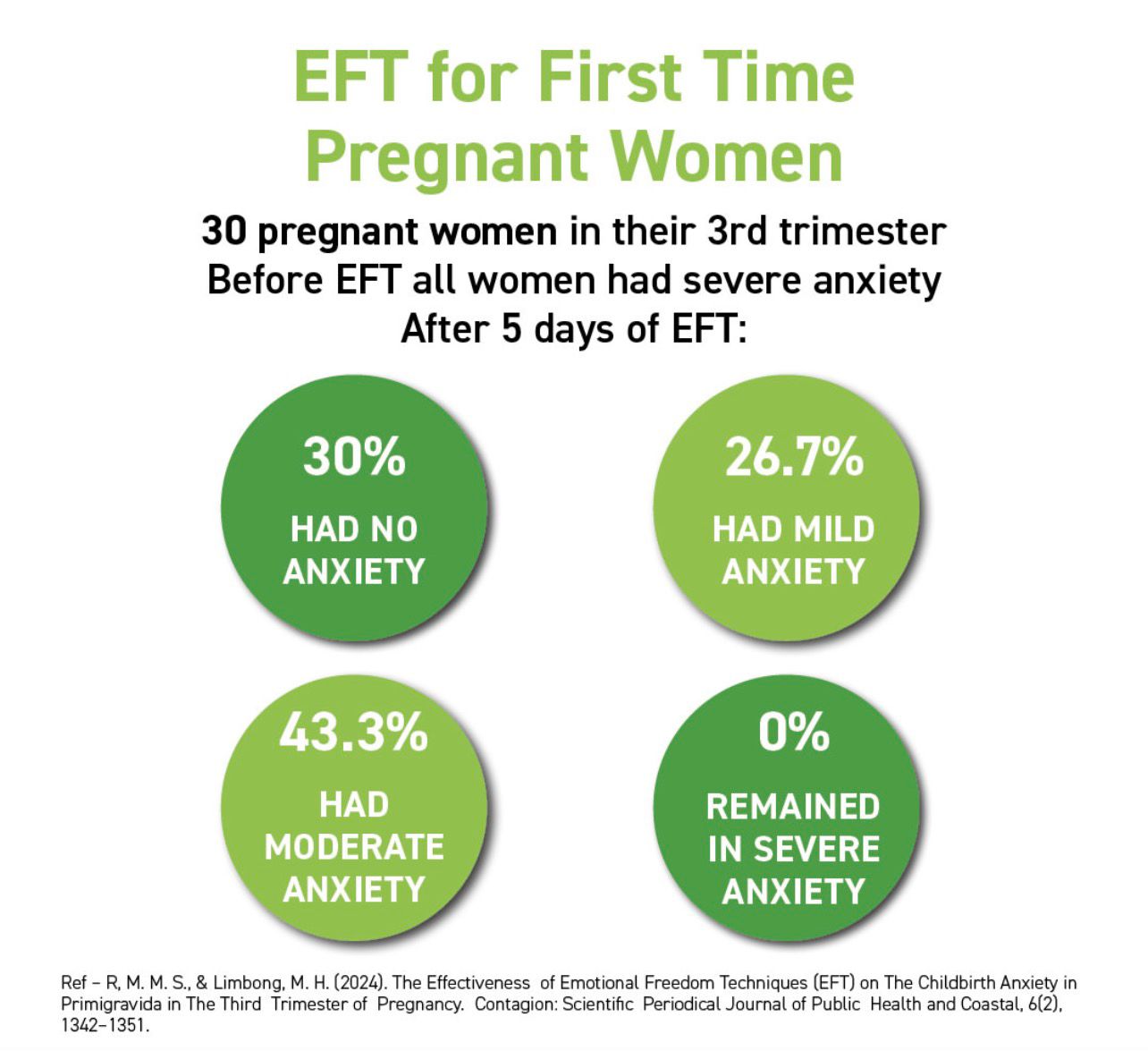
1. Before EFT
- 100% of participants were classified as having severe anxiety
2. After Five Days of EFT
- 30% reported no anxiety
- 26.7% reported mild anxiety
- 43.3% reported moderate anxiety
- 0% remained in the severe anxiety category
This shift represents a substantial reduction in anxiety severity within a short intervention window.
Statistical Findings
The statistically significant reduction indicates that EFT had a measurable and clinically relevant impact on childbirth anxiety in this sample.
The Impact of Childbirth Anxiety
The study highlights that anxiety during pregnancy is not merely emotional discomfort — it carries physiological consequences. Elevated anxiety can:
- Increase cortisol levels
- Disrupt oxytocin secretion
- Weaken uterine contractions
- Prolong labour
- Increase risk of infection and maternal fatigue
- Contribute to preterm birth and low birth weight

The research also notes that approximately 28.7% of pregnant women in Indonesia experience anxiety when facing childbirth.
Managing anxiety before labour is therefore clinically relevant.
How EFT Helps Ease Childbirth Anxiety?
According to the study, EFT combines elements of cognitive and behavioural therapy with stimulation of acupressure meridian points.
The method involves tapping on specific points while focusing on anxiety triggers. The researchers suggest that this may help regulate emotional responses and reduce psychological distress.
EFT is described as:
- Non-pharmacological
- Low-cost
- Simple to implement
- Free from medication side effects
This makes it suitable for integration into maternal and community health services.



It can be delivered in group antenatal settings or taught individually as part of third-trimester preparation.
Because it is simple and structured, it can empower expectant mothers with a self-regulation tool they can continue using independently.
What Makes This Study Important?
This research is significant because it addresses a common yet often under-supported aspect of maternal care — emotional regulation before birth. It also provides measurable data within a clinical setting rather than relying solely on anecdotal outcomes.
Although the study had limitations — including small sample size, absence of a control group, and short intervention duration — the statistical findings indicate a meaningful reduction in anxiety levels.
Larger randomised controlled trials would further strengthen generalisability.
Clinical Implications
The researchers conclude that EFT may be considered as a complementary intervention within maternal and child healthcare settings. Because it is accessible, low-cost, and safe, EFT may be incorporated into:
- Antenatal education programs
- Third-trimester preparation
- Community health services
Reducing anxiety before labour may support both emotional wellbeing and physiological readiness for birth.

EFT Tapping Sequence to Ease Anxiety
Below is a simple, generic EFT tapping sequence that can be practiced to reduce anxiety and calm the nervous system.
Step 1:
Identify the feeling
Take a moment to notice:
- What am I feeling right now?
- Where do I feel it in my body?
- On a scale of 0–10, how strong is it?
Be specific. Anxiety may feel like tightness in the chest, heaviness in the stomach, or racing thoughts.
Step 2:
Karate Chop Point (side of hand) – Repeat 3 times
Such as:
- “Even though I feel this anxiety, I accept how I feel right now.”
- “Even though my body feels tense, I’m open to feeling calmer.”
- “Even though part of me is worried, I allow myself to soften.”
Step 3:
Tapping through the points - Acknowledging the anxiety
- Eyebrow - “I feel this anxiety in my body.”
- Side of Eye - “My mind keeps predicting what could go wrong.”
- Under Eye - “This tight feeling in my chest.”
- Under Nose - “I feel tense thinking about it.”
- Chin - “My body is holding stress.”
- Collarbone - “All this worry in my system.”
- Under Arm - “I notice how activated I feel.”
- Top of Head - “This anxiety running through me.”
Step 4:
Addressing the fear
- Eyebrow - "Part of me is afraid."
- Side of eye - "I do not like the uncertainty."
- Under eye - "I want things to go smoothly."
- Under nose - "My mind keeps preparing for problems."
- Chin - "I have been on alert."
- Collarbone - "My nervous system feels overstimulated."
- Under arm - "I have been carrying this tension."
- Top of head - "This anticipatory anxiety in my body."
Step 5:
Supporting regulation
- Eyebrow - "Right now, I am safe."
- Side of eye - "I can breathe through this moment."
- Under eye - "My body knows how to settle."
- Under nose - "I do not need to solve everything at once."
- Chin - "I allow some of this tension to release."
- Collarbone - "My nervous system can regulate."
- Under arm - "I feel a little steadier now."
- Top of head - "I choose calm and balance."
Step 5:
Close
- Take a slow breath in and out.
- Re-rate the anxiety from 0 to 10.
- If intensity remains above 3 or 4, repeat the sequence focusing on any remaining physical sensations or specific fears.
Why Calm Before Big Moments Matters?
You don’t need to be in active labour to feel the weight of anticipation.
In the final weeks of pregnancy, thoughts can become louder. Appointments feel more serious. The mind starts rehearsing possibilities. Even small conversations about birth can trigger tension in the body.
Childbirth anxiety does not always look dramatic. Sometimes it shows up as a tight chest before a check-up. Difficulty sleeping as the due date approaches. Replaying “what if” scenarios late at night.
EFT Tapping is not just for moments of crisis. It can be used whenever the nervous system feels overstimulated or unsettled.

A few minutes of tapping before bed can quiet racing thoughts. Tapping after a medical appointment can ease lingering tension. Tapping when fear arises can help the body return to steadiness.
Small, consistent regulation builds emotional resilience — and in the final trimester, that steadiness can make a meaningful difference.
EFT Tapping and the Growing Evidence Base
This study contributes to a broader and growing body of research on Emotional Freedom Techniques as a mind–body intervention.
Research over the past two decades has examined EFT for:
- Anxiety and stress disorders
- Depression and PTSD
- Chronic pain and somatic symptoms
Systematic reviews and meta-analyses report moderate to large effect sizes for reducing psychological distress. Biological research has also documented measurable changes, including reduced cortisol levels and improved heart-rate variability.
What makes EFT especially practical is that it is:
- Self-applied
- Non-invasive
- Equipment-free
- Free from medication side effects
It offers a simple way to support nervous system regulation when stress levels rise.
For Therapists, Healers, and Coaches
If you already use EFT or nervous system–based approaches, research like this reinforces what you see in practice. When a client’s breathing slows or their body softens, regulation is happening in real time.
If you are new to EFT, begin with your own practice. Learn to use it for stress and emotional steadiness first.
Because sustainable change is not dramatic — it is built through small, consistent shifts that restore balance.
CONCLUSION
Childbirth anxiety is common among first-time mothers in the third trimester.
This 2024 study demonstrated that five days of structured Emotional Freedom Techniques practice significantly reduced anxiety levels in primigravida women. Severe anxiety was eliminated within the sample, and measurable improvements were observed across participant.
A few minutes a day. A few gentle taps. A simple pause before labour begins.
And within that small daily practice, the body begins to feel steadier and more prepared.
Love,
Dr Rangana Rupavi Choudhari (PhD)
P.S. Want to discover if EFT is right for you? Book a Complimentary Discovery Call.

Childbirth anxiety in the third trimester can create both emotional tension and physical strain for first-time mothers. Worries about labour, complications, and the unknown can heighten stress levels just as the body is preparing for birth.
Emotional Freedom Techniques (EFT) offer a simple, non-pharmacological way to support emotional regulation during this period. By tapping on specific acupressure points while focusing on childbirth-related fears, EFT may help calm the nervous system and reduce psychological distress.
A 2024 study published in Contagion: Scientific Periodical Journal of Public Health and Coastal found that five consecutive days of EFT practice significantly reduced severe childbirth anxiety in primigravida women during their third trimester.
With consistent practice, anxiety levels decreased, and participants moved from severe distress to mild or no anxiety — suggesting that structured emotional regulation can meaningfully support preparation for labour.
References:

Learn Emotional Freedom Techniques for self healing or to become professionally qualified - More
Our other seminars:
For the full calendar of events.
Other articles you may be interested in: